1976
104’ (25 fps) / 1.66:1

BOMBER & PAGANINI

BOMBER & PAGANINI /

DIRECTED BY:
Nikos Perakis
SCRIPT:
Nikos Perakis
BOMBER & PAGANINI poster

The idea for the film came to me from Alexander Kluge, who besides being an intellectual, theoretician, and auteur filmmaker, was ‒ and still is ‒ a lawyer, and one of the authors of the Oberhausener Manifest (1962), considered the founding declaration of the Young German Film, and which was followed in 1966 by the "Working Community Of New German Film Producers" and in 1967 by the "Film Funding Law", which was the beginning of dozens of subsidies and grants from federal, national, municipal, television, and many other organizations.

One evening at the U.L.M. kitchen table, Alexander referred, among other legal curiosities, to an exercise for law students where a paralyzed guy sees a treasure chest in a field and directs his blind friend to the spot, where he picks it up. Who is the owner of the treasure? Of course it is the blind man, who could actually take the chest in his hands. Shortly after, in May of '73, a huge headline ap-peared in a local newspaper: "BLIND MAN AND PARALYTIC steal police car". After that I started writing this script.

PLOT

The film is literally the story of the lame leading the blind. Bomber, the drunkard boxer and former pianist, and Paganini whose nickname comes from his virtuoso skill on the violin, are two of life’s losers, hanging around with a gang of thugs and hookers in a two-bit dive called the Wunder Bar.

In the course of an unbelievably bungled burglary Bomber loses his eyesight and Paganini is crippled. Condemned to make common cause, Bomber finds himself blindly pushing Paganini’s wheelchair through the mean streets, while the lame Paganini acts as navigator. Waiting for a miracle to happen, they are surprised by a golden opportunity: It seems the gang is planning to rob an armored cash transport and Paganini has worked out a risky scheme to take advantage of their getaway.

CAST+CREW

In July 1974, just a few days after the fall of the junta and the return of Karamanlis, I came to Athens to get myself a dose of euphoria after six years in Germany. I had a first draft of the script with the two little invalid gangsters as heroes, and since I wanted to stay here I went down to the port of Piraeus to find shooting locations. The atmosphere of the harbour and the ships was ideal. I wanted to put Bomber and Paganini in a ship packed with pilgrims and to send them to the Virgin Mary’s island Tinos, where after a miracle, the blind one would see, and the paralytic would chase him through the marble quarries of Panormos. Awesome places, but the general atmosphere in the country made me feel alienated. Friends and colleagues were more interested in the civil war (1946-49) than the recent seven-year dictatorship, and I had already witnessed the dispute of the "new" versus the "old" or "Grandpa’s Cinema" in Germany, where I now returned in disappointment. Finally I found the locations, and my "in-between" associate producer von Vietinghoff set up a serious co-production in grey and declining imperial Vienna and its surroundings. Anyway, "The Third Man" is still one of my beloved movies.
Besides the main roles and some collaborators with whom I started pre-production in Munich, the actors and the crew were Viennese.

ΔΙΑΝΟΜΗ

Bomber
.Mario Adorf
Paganini
Tilo Prückner
Mona
Barbara Valentin
Mina
Margot Werner
Mama
Hannelore Schroth
Court Doctor
Fritz Weiss
Prison Guard
Willy Hufnagel
Lip-Stick
Rainer Artenfels
Hooker 4th Floor
Hannelore Elsner
Butscher
Peter Jost
Herr Schorsch
Heinz Winter
Herr Dobermann
Heinrich Schweiger
Malingerer
Otto Tausig
Syndicate Secretary
Hark Bohm
Court Balliff
Otto Amross
Policeman
Kurt Sowinetz
Taffeta Mitzi
Erzsi Szablinski
Pastor
Bruno Thost
Kamikaze
Karl Krittl
Police Officer
Michael Janisch
Piano Player
Ralph Toursel
Fat Hooker
Delia Carsten
Slim Hooker
Holde Naumann
Policeman
Gottfried Blahovski
Toilet Woman
Elisabeth Essel
Farmer
Hans Habietinek
Mover
Karl Zerda
Tramway Band
Wiener Strassenbahner Kapelle

ΣΥΝΕΡΓΑΤΕΣ

Writer+Director
Νίκος Περάκης
Co-writers
Joe Hembus,Uli Greive
Director of Photography
Dietrich Lohmann
Set Designer
Winfried Hennig
Costume Designer
Gera Graf
Executive Producer
Joachim von Vietinghoff
Production Director
Otto Boris Dworak
Music by
Nikos Mamangakis
Song Lyrics by
Nikos Perakis
Sound engineer
Rolf Scmidt Gentner, Karl Schliefelner
Edited by
Siegrum Jäger
Make-up Artist
Alfred Merheim
Props Master
Margarete Graef
Still Photographer
Chotoku Tanaka
Stage Manager
Jussuf Koschier, Elisabeth Szablinski
Assistant Director
Peter Fratscher
Script+Continuity
Babatte Raitmeyer
Assistant Cameraman
Attila Szabo
Gaffer
Erich Kristufek
Key Grip
Walter Knaus
Assistant Editor
Claudia Rienek
Set Dresser
Fritz Hollergschwandtner
Special Effects
Helmut Graef
Production Assistant
Beatrix Waizenauer
Production Secretary
Christine Fall
Production Accountant
Alfred Ebinger
Wardrobe
Waltraud Freitag
Costumers
Lambert Hofer
Lighing+Grip Equipment
Wien Film GmbH
Film Laboratory
Wien Film Grinzing
Music Recording
Wien Film GmbH
Vocals
Margot Werner
„Wunder Geschehen“
Polydor Nr.2041772
ZDF Producer
Christoph Holch
Production
Vietinghof & Perakis Filmproduktion
Co-producers
Zweites Deutsches Fernsehen
in co-operation with Sascha Film GmbH Wien
Distribution
Constantin Film


© 1976 v.VIETINGHOFF/N.PERAKIS/ZDF/SASCHA FILM

Duration 104’(25 fps)
EASTMAN Color 35 mm
Frame Aspect 1.66:1

POSTERS+LOBBY CARDS

STILLS+FRAMES

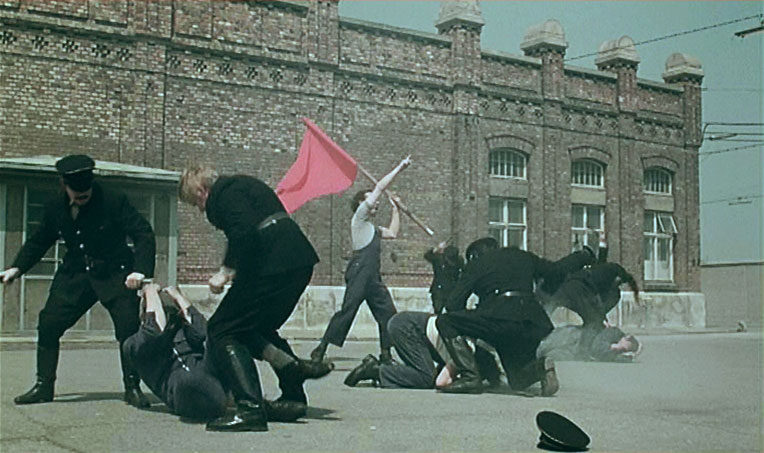
Every time we talked with Lohman about the photography of the film, we came to the conclusion that we had to shoot it in black and white. Unfortunately our co-producer ZDF would never allow that, since they had invested in colour television, nor would our distributor Constantin Film, who didn’t want any kind of an "artistic" film.

That's why I was delighted to meet Chötoku Tanaka, a Japanese art photographer who was shooting pictures of Vienna and wanted to add some movie work to his portfolio. Of course he wanted black and white photographs and we had to insist to get him to shoot some in colour for the dashboard.

I’m glad he is strong and still shooting pictures.

SCENES

In the movie's reference sound track – post-synced – the dialogues are in German. I chose some scenes with little or no dialogue because the German version is not subtitled in Greek or English. In the meantime, Claudio* showed me a program which allows one to lift the Greek subtitles from the English version and put them onto the German original, which I have done, with the risk that the translation of some English idiom may not match the corresponding German dialogue. German speakers must forgive me for this. When the English version was done, in 1976, the English dubbing was considered very good, but the original is still better, especially the "Syndicate Tango" sung by Margot Werner (1937-2012), which is in German and was uploaded by her fans on the Internet. These are the first and last lyrics I was allowed to write in German.

While searching I found a blog that recalls the movie from the BBC2 broadcast in 1977. The most interesting thing is that it extols the actors and does not even mention the screenwriter or the director; it's the same on the most recent German DVD. We mustn't scare the buyer, one thinks, with an unknown director whose name will appear anyway in the head titles. It’s only in Greece that they consider us important and invite us to talk shows and opening nights.

* Claudio Bolivar is the director of photography on my latest films.

MAKING OF

This pseudo-interview* was filmed in 2004, for the extras on the DVD -instead of a "making of". The DVD was released by Arthaus of KINOWELT when it acquired the video rights for all "Filmverlag der Autoren" films. The company – here we might call it "Film Authors Publishing" - was founded in 1971 by a dozen Filmmaker inter alia Kluge, Wenders and Fassbinder, initiated by Hark Bohm, who in the film plays the "Syndicate" lawyer. From that time it was fashionable – and necessary – for friends to contribute by playing small parts. Well-known actors avoided these roles and it would have been a pity to use untalented or bit-part performers. Filmverlag, which was founded to secure for filmmakers better distribution arrangements than they could get with the big commercially oriented companies, went through many crises, mergers and acquisitions before being acquired by KINOWELT, and then both by the French company STUDIOCANAL in 2011.

* At this time it will be understood only by those who have studied German, but when all films are uploaded, and if the site budget is not exhausted, I will try to subtitle all clips, or as many as I can find time for in this vain world.

WORK PHOTOS

It was necessary to scout locations in Vienna during the winter, guided by the production manager Otto-Boris Dvorak. I saw many locations that had been used by Carol Reed, most of which had become tourist attractions - maybe they were already then. We were still talking about a black and white film, and I shot hundreds of B/W photos which I developed and enlarged in the kitchen of my apartment on cheap A4 paper intended for some other, industrial use. Some years later I threw a couple hundred of them away; they had blackened because I hadn't left them long enough in the fixer.(Sodium hyposulphate, I think.)

The shoot was photographed by Chötoku and at the end he sent me some pictures, obviously the ones chosen by Constantin Film for the press, since I seem to be incessantly directing the same two or three actors, apparently the most popular.

More in the captions.

TEASERS+TRAILERS+TV SPOTS

VIDEO CLIPS+MUSIC THEMES

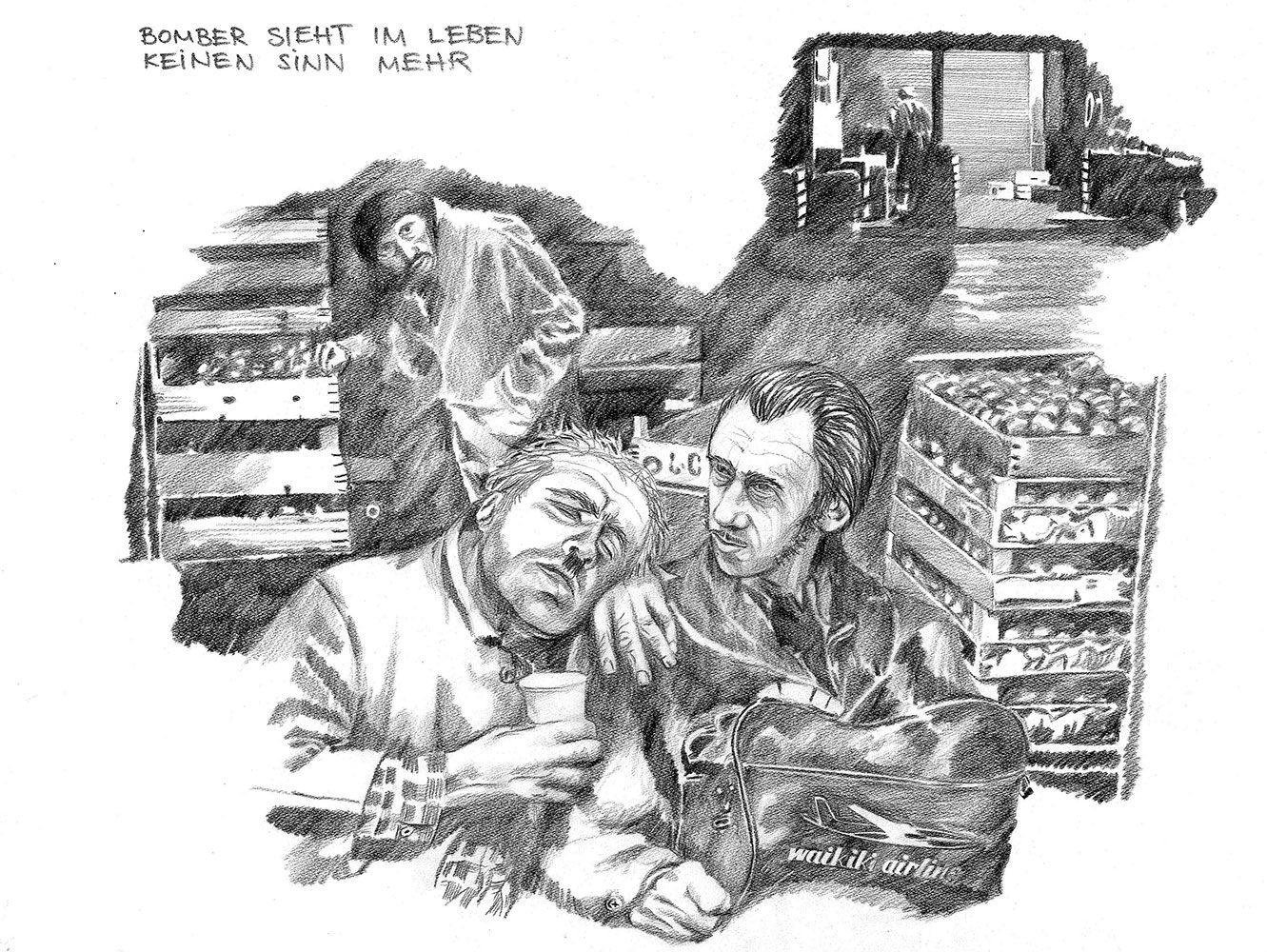
SHOOTING BOARDS+SCRIBBLES

I got a lot of help on the second draft of the script from my friend Joe. Joe Hembus was a historian of the German cinema and the American western, with many books to his credit. In endless conversations he urged me to identify the genre of film that I was going to shoot, since I had been trying to define it with drawings of characters and locations. He made me do a hypothetical casting with Karl Malden as Bomber and Dustin Hoffman as Paganini. So the name Sekulovich came into the story, which was Malden's real name, and fit the remains of the Austro-Hungarian Empire and post-war Vienna. Joe also made the first contact with Mario Adorf, whom I considered an unapproachable star with an impenetrable manager. I myself persuaded Tilo Prückner to play Paganini, first because we had worked together in little theatres in '64 and'65, secondly, we had collaborated recently on films of friends such as Hauff, Gall, Sinkel and Brustellin, and thirdly, we were neighbours living on the same floor.

Uli Greive was hired to improve the dialogues when we had to submit the script with the production folder to the "Film and Television Convention" committee. Uli created a peculiar but undefinable dialect for the German-speaking underworld. Note that most of the members of the committee were philologists; the rest were lawyers...

* Unfortunately it’s the anniversary of the April 21st military take-over that always reminds me of Joe, since we lost him in a ravine in the Alps on 21.04.1985.