2005
111’ (25 fps) / 1.85:1

SIRENS IN THE AEGEAN

ΣΕΙΡΗΝΕΣ ΣΤΟ ΑΙΓΑΙΟ / SIRINES STO EGEO

DIRECTED BY:
Nikos Perakis
SCRIPT:
Nikos Perakis
ΣΕΙΡΗΝΕΣ ΣΤΟ ΑΙΓΑΙΟ poster

If the Imia crisis, as I followed it in the press and on television, hadn't ended so tragically, the Greek-Turkish episode could have become a very funny movie, not of course without the support of the military and its ships and planes. But I never had such luck, and that’s why I started thinking of a smaller story. After "LOAFING AND CAMOUFLAGE", and having appeared several times on television to promote the film, I would be stopped on the street by strangers of different ages who wanted to tell me the story of their own service in the army, which they usually insisted was funnier than my movie. I listened patiently to some of them, but when I didn’t have time I told them to write it out and secure their copyright before sending it to me, because in this business everyone steals from everyone else. I never received a manuscript, but before I started writing I heard several surreal and quite a few horrifying stories about the Evros River border and the rocky islets of the Eastern Aegean.

In the end, in order to bring everyday authenticity to the privileged Headquarters soldiers, Renos organized for me an evening with some buddies who had served with him on the island of Kos. When I went to Istanbul to find actors, Biket, the Turkish producer who had read the script to organize the casting, told me about a Turkish blockbuster, made with the full support of the army, which ends with the simultaneous capture by Greek and Turkish commandos of a volcanic islet that was created suddenly by a strong earthquake in the northern Aegean. Although Biket assured me that there was no resemblance to my project, I was very curious and viewed the film. The inventive touch was an insert toward the end to show the readiness of the Turkish Army, which was the major co-producer, but also an excellent opportunity to show the superiority of the Turkish lad, who asks his sweating Greek antagonist to light his cigarette before letting him go with his life.

When I returned to Athens, in my infinite naivety I sent the Turkish film to the then Prime Minister’s spokesman, a well-known journalist, asking him to intercede with Army Headquarters, which might be persuaded to be shamed into giving us some, albeit rusty, G3s or M16s for the soldiers and an automatic G31 for the sergeant. Naturally I never got an answer so finally the soldiers' weapons were all plastic replicas, and the other equipment came from military surplus yards. The only metal replica found in the market, was a Kalashnikov and then I got the idea of calling it "Kalashnikaki" by adding the typically Cretan suffix "-aki" and gave it to the wild Cretan Minos Stavrakomathiakakis.

PLOT

The Turkish yacht Ege Güzeli (Aegean Beauty) puts two men and a six-year-old girl ashore on a rocky little Greek island. The three are illegal immigrants and castaways who were rescued by the Turks in Greek territorial waters. Apart from the captain and a deckhand, there are three women on board, two of them contestants in a beauty pageant and a former winner, as well as a reporter and a cameraman from the local Turkish network that organizes the annual event.

The six Greek soldiers stationed there force the crew and passengers to disembark and impound the yacht. To complicate things even further, the military telecommunications system is down (Siemens?) and one of the models is the niece of a Turkish Admiral. The sincerity of the soldiers, the natural beauty of the girls, the patriotism of their companions and the despair of the illegal immigrants further confuse and complicate the situation. This leads to an international geo-political crisis and possible hostilities between Greece and Turkey, but also contributes to deconstruction of stereotypes and prejudices.


I belong to the generation with the most enemies. Since I was a small child I had learned the enemies of my country. In the morning at the public school it was the Turks, who slaughtered women and children before being slaughtered in turn, whole armies of them, by Greek Armatoloi and Klephts. But in the afternoon we played "Little Hero" and I had a dual role: besides Spithas (Sparky) I had to play a German sentry, who got stabbed in the throat by the legendary "ghost child". In high school we had many more enemies: Bulgarian Komitas in our swamplands, our Greek communist mobsters whom we chased out of the country as we had the Nazis before them, the British colonialists in our Cyprus, the Turks in our Constantinople and all the communists behind the Iron Curtain.

After high school, in '62, I went to Germany where I worked with all of the above in a locomotive and tank factory at Dachau - fortunately for only three months. But then my professor at the Fine Arts Academy and Opera had been an NSDAP party member during the whole of World War II, while some students with whom I scraped the ice from sidewalks at 4 a.m. were not only Turks but also communists. I went back to serve in the Greek army in '66, and in '67 I revolted with my colonels and we confined all our internal enemies. In '69 I returned to Germany and got serious. In June '74 I was doing costumes for a film of a Henry James story at Berman's & Nathan's in Camden Town, the Cypriot district in London. There I shared their drama and quarrels from the coup d’état to the Turkish invasion a few days later. There I began to realise how difficult the management of stereotypes and prejudices is, but also how serious is the deficit of self-knowledge that afflicts us.

In "LOAFING and CAMOUFLAGE", although I had many characters, I could not undo even the stereotype of the collective resistance against the junta. In "SIRENS" I would have far fewer soldiers, isolated in a minimal space, and many other enemies: Turks, Kurds and Asians, smugglers and illegal immigrants, tough men and fatal Ottoman women, intellectuals, Muslims and communists. A whole world of stereotypes, spread like traps on land and water contested by the "enemy".

This is how I tried to explain my intentions to the Greek Film Centre's Scenario Committee and Board when they asked me for an interview. The prevailing view was that the movie would be difficult for the average viewer* and I tried to dissuade them. When the GFC gave us a negative answer I just got angry, but when I heard from an insider that the real reason for the rejection was that the script was not only "abstruse" but also "anti-Hellenic", I realized what was really bothering them and I felt confident enough to go ahead and shoot SIRENS.

* When released by ODEON the film became an all-time box office hit for a Greek movie, with about 1.5 million viewers, and the second biggest after "Titanic", another abstruse movie.

CAST+CREW

POSTERS+LOBBY CARDS

STILLS+FRAMES

SCENES

MAKING OF

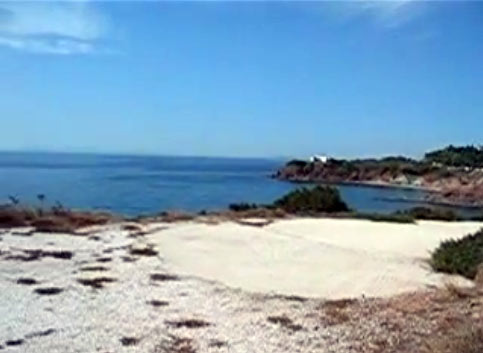
Apart from the few on Kos, most shootings were for obvious reasons not near the Turkish coast, but on the uninhabited islet Slayer in the South Euboea Gulf near New Styra, on a cape in Anavissos which we baptized Calypso after the nearby hotel that hosted us, and even at a primary school in Athens where we shot the exteriors and interiors of the "High Command of the Dodecanese", for cost reasons of course. The absence of the Greek Film Centre, the Army, and any other sponsors forced us to "split" and "cheat" locations like in all my films before and after "SIRENS". When I went to Bodrum, supposedly to scout locations, there was still some hope of finding a Turkish co-producer. Luckily I also shot several photos and videos while I was there, and the Turkish TV reports were all done with the proven chroma key technique as was the US aircraft carrier that suddenly appears and anchors just off Pitta. Maybe it was these adversities that made us all, actors, crew and friends, work tirelessly and with such high spirits.

WORK PHOTOS

VIDEO CLIPS+MUSIC THEMES

On Friday the 1st of June 2005, we all went down to cape Calypso because we had several jobs to do: visit the main site with the actors, try on their uniforms and outfits, do some precision exercises with their weapons, shoot footage for the music video, and take some pictures for a press conference. The plan for the video was to get as many shots as possible in different places and situations. The shooting of the music video would become the actors' nightmare when after the shooting they saw the ghetto blaster coming out of its box with the playback of "Just In My Madness". Of course for each take we sang it all the way through in order to have lots of footage to edit.

SHOOTING BOARDS+SCRIBBLES

ASIDES